

A new doctoral thesis defended by the ALBA group analyzes the communication and interactions of Spanish rare disease associations on Twitter/X
Tesis Marta 1

A new doctoral thesis defended by the ALBA group analyzes the communication and interactions of Spanish rare disease associations on Twitter/X

Tesis Marta 1

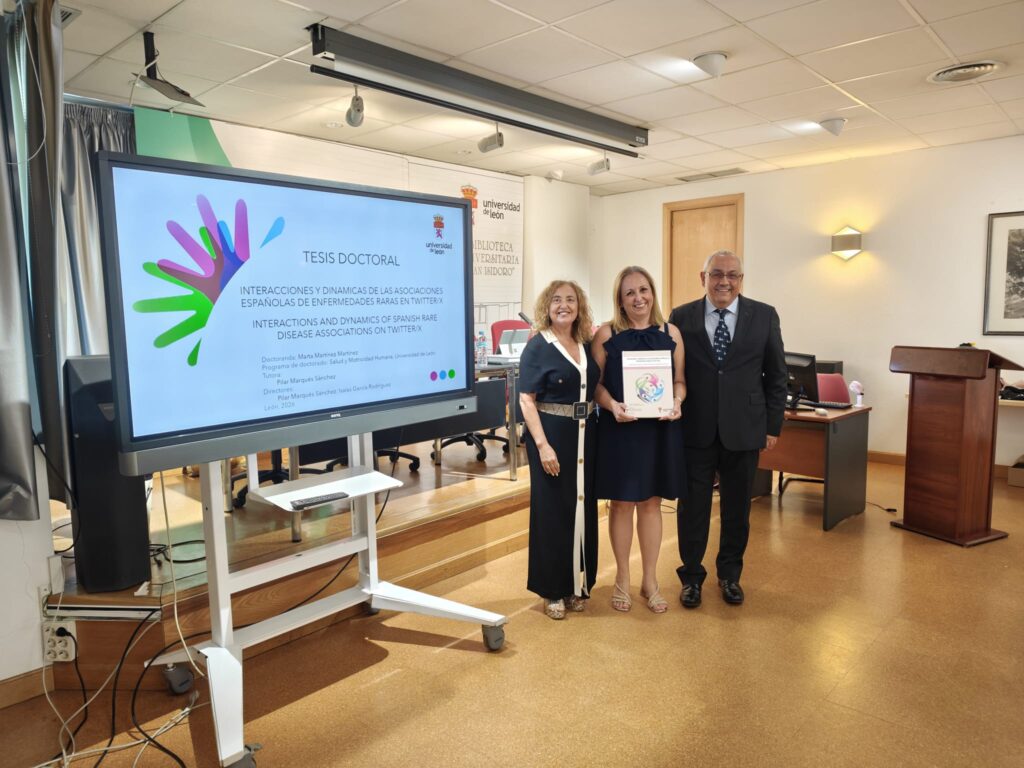
On July 30, 2026, our colleague Marta Martínez Martínez defended her doctoral thesis, titled “Interactions and dynamics of Spanish rare disease associations on Twitter/X,” at the San Isidoro University Library of the University of León.

The research analyzes the activity of Spanish rare disease associations on Twitter/X, paying special attention to how they interact with each other and with other actors, what characteristics their messages present, and what factors influence the attention their posts receive, measured through retweets and likes.

The work combines different methodological approaches, such as social network analysis, content analysis, and statistical models. Additionally, it incorporates Antonovsky’s salutogenic framework and sense of coherence to study the communication developed by these organizations.

The results highlight the role of social media as spaces for information, visibility, support, and connection for associations and people living with rare diseases, a group especially conditioned by the low prevalence and dispersion of these pathologies.

The defense was attended by several colleagues from the ALBA research group, who accompanied Marta at this important moment in her academic and research career.

The thesis, developed within the doctoral program Health and Human Motricity, was supervised by Dr. Pilar Márqués Sánchez and Dr. Isaías García Rodríguez, and received the grade of summa cum laude.

Explainable Artificial Intelligence Opens New Avenues for Depression Detection from Language

Visual Abstract Depresión

Explainable Artificial Intelligence Opens New Avenues for Depression Detection from Language

🧠🤖 In mental health, obtaining a prediction is not enough: we also need to understand how it was generated.

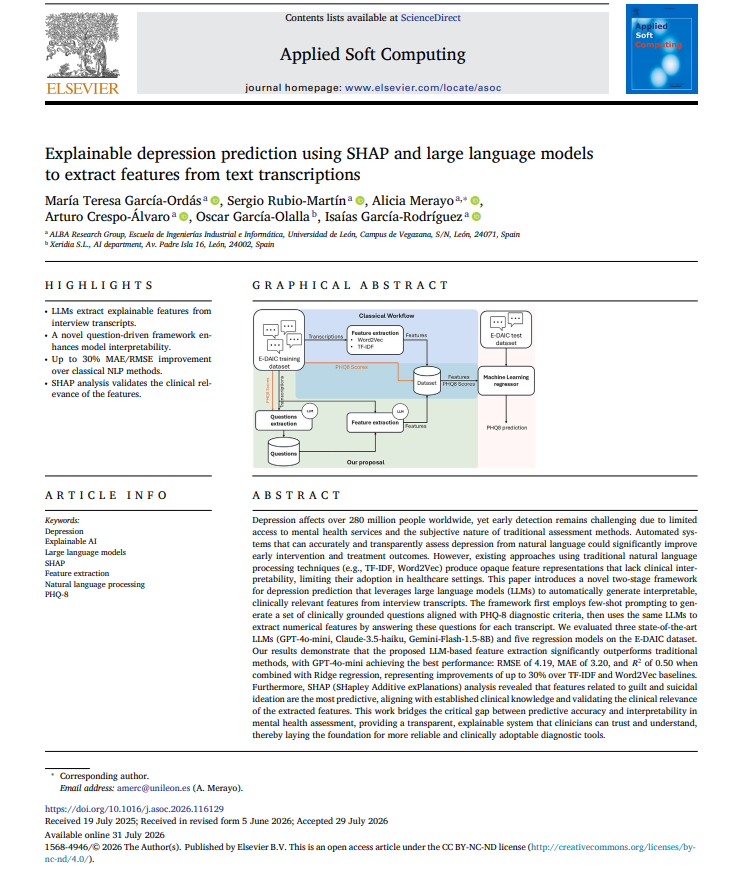
From the ALBA group at the University of León, in collaboration with Xeridia’s Artificial Intelligence Department, we have developed a method to estimate the severity of depression from clinical interview transcripts.

In our work, we use large language models to transform the content of interviews into ten interpretable variables, linked to clinical dimensions of the PHQ-8. From these, a regression model calculates the estimated score, while SHAP allows us to understand the influence of each variable on the result. 🔍

📊 The combination of GPT-4o-mini and Ridge reduced the error by up to 30% compared to traditional representations like TF-IDF and Word2Vec. Additionally, we identified feelings of guilt and suicidal ideation among the factors with the highest predictive relevance.

Our study combines language models, predictive capability, and clinically understandable explanations to advance towards more transparent artificial intelligence tools in the field of mental health.

📄 Published in Applied Soft Computing
🔗 https://lnkd.in/euZ4B6hU

🤝 ALBA Research Group (University of León) · Xeridia

depression-paper-cover